Concurrency Basics
How it works
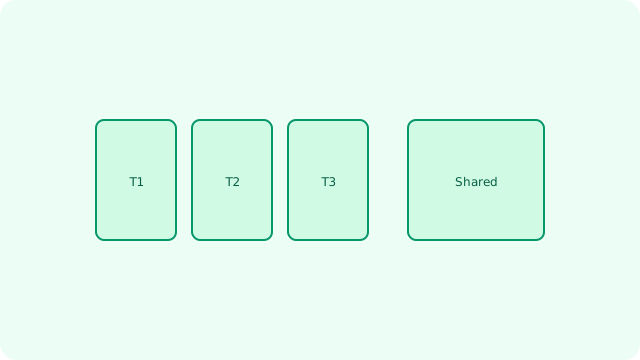
- Input arrives
- Core component processes
- Result produced
- Observe and iterate
Overview
Understand race conditions, deadlocks, thread safety, and when to use immutability, locks, or lock-free structures.Learning Objectives
🎯 Thread Safety Fundamentals
Master the principles of thread safety, race conditions, and synchronization mechanisms
🔧 Concurrent Patterns
Learn essential patterns like producer-consumer, reader-writer, and thread pools for efficient concurrent programming
⚡ Performance & Correctness
Understand the trade-offs between performance and correctness in concurrent system design
Real-World Examples
🏦 High-Frequency Trading
Goldman Sachs uses lock-free data structures and atomic operations for nanosecond-level trade execution with minimal latency
🎮 Game Engine Threading
Unity's job system uses worker threads with lock-free queues to parallelize physics, rendering, and AI calculations
📊 Real-time Analytics
Netflix's analytics pipeline uses concurrent collections and thread-safe aggregators to process millions of events per second
🌐 Web Server Architecture
NGINX uses event-driven concurrency with worker processes and thread pools to handle thousands of concurrent connections
Code example
Limit concurrent tasks with a simple semaphore in Node.js/TypeScript:class Semaphore {
private count: number; private queue: Array<() => void> = [];
constructor(count: number) { this.count = count }
acquire(): Promise<void> {
if (this.count > 0) { this.count -= 1; return Promise.resolve() }
return new Promise((resolve) => this.queue.push(resolve));
}
release(): void {
if (this.queue.length > 0) { var r = this.queue.shift(); if (r) r(); }
else { this.count += 1 }
}
}
async function runWithLimit(tasks: Array<() => Promise<unknown>>, limit: number): Promise<unknown[]> {
var sem = new Semaphore(limit);
var out: unknown[] = [];
await Promise.all(tasks.map(async function (t) {
await sem.acquire();
try { out.push(await t()); }
finally { sem.release(); }
}));
return out;
}
Implementation Notes
- Use immutable data structures when possible to eliminate race conditions
- Prefer atomic operations and compare-and-swap over traditional locking
- Implement thread pools to manage resource consumption and prevent thread explosion
- Use concurrent collections (ConcurrentHashMap, BlockingQueue) instead of synchronized wrappers
- Consider actor model or message passing for complex concurrent system design
Best Practices
- Design for immutability first, add mutability only when necessary for performance
- Use well-tested concurrency libraries instead of implementing synchronization primitives
- Implement proper cancellation and timeout mechanisms for long-running tasks
- Use thread-safe logging and monitoring to debug concurrent issues effectively
- Test concurrent code with stress testing and tools like ThreadSanitizer
Common Pitfalls
- Creating race conditions by accessing shared mutable state without proper synchronization
- Causing deadlocks by acquiring locks in different orders across threads
- Using fine-grained locking that creates more overhead than performance benefit
- Forgetting to handle interruptions and cancellation in long-running concurrent tasks
- Not considering memory visibility issues when sharing data between threads